Setouchi Triennale and Regional Revitalization
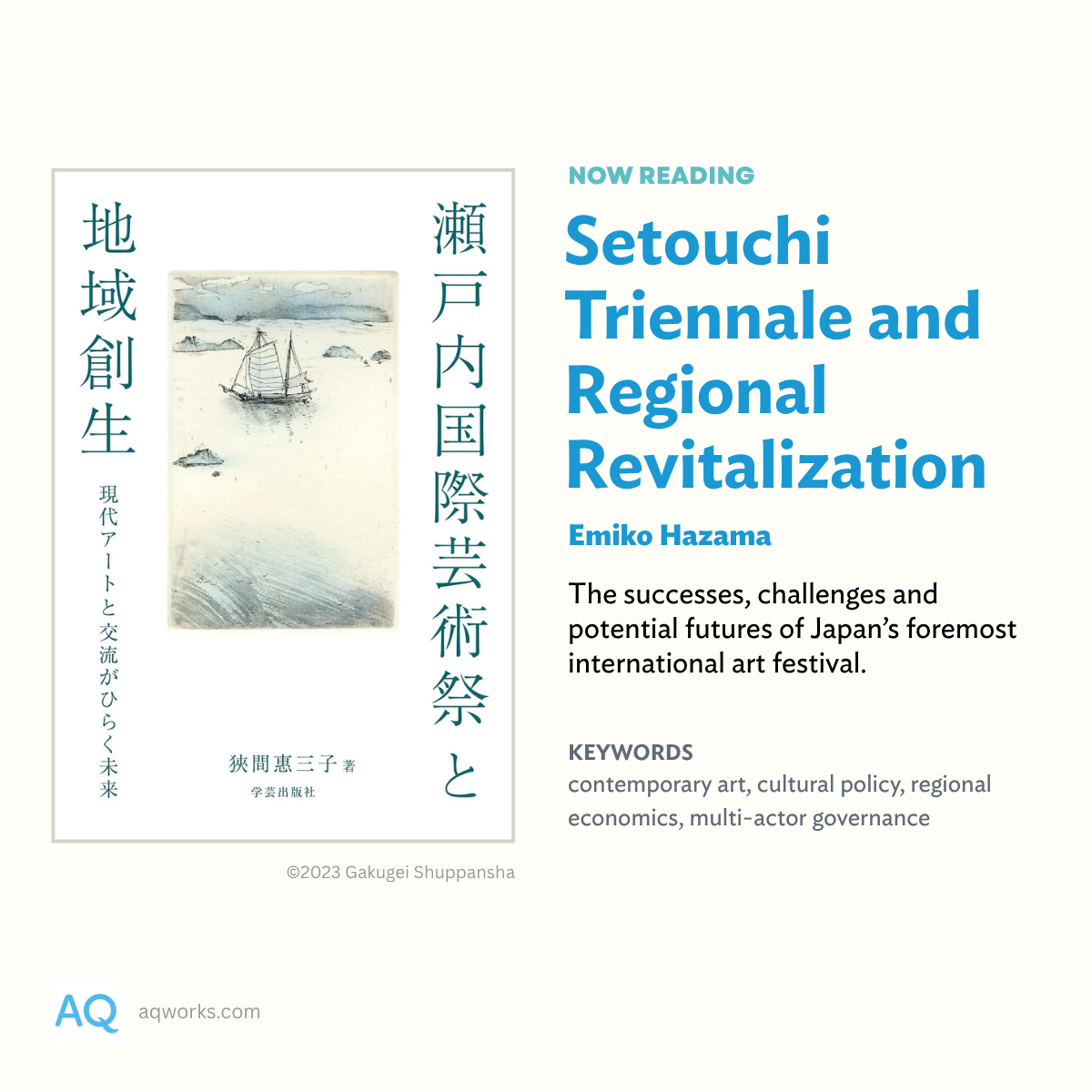
My team decided 2026 would be a year of books from Japanese-language discourse to build broader context for client work. It’s been energizing and I want to share reflections from time to time.
Here’s the first one.
The Setouchi Triennale was inspired by the desire to bring smiles back to the faces of the islanders, particularly the elders. To do this, it must contribute to a brighter future for local communities and ensure that visitors are a source of joy. Our aim is to restore and revitalize the entire region. https://setouchi-artfest.jp/en/
The Setouchi Triennale holds a special place in my heart. It was my first client at AQ, and the Seto Inland Sea became a place where I didn’t have personal ties but felt connected to nonetheless. There are hundreds of works across 17 islands accessible via foot, bicycles, and ferries.
This book traces the festival from its inaugural year in 2010, in economic terms but also migration patterns, community pride, and local assets. Multi-stakeholder governance runs throughout–how well local governments, private actors, and residents work together as a condition of its success.
A thesis of such initiatives is to expand the idea of the human population from “who lives here” to “who’s involved here”. This reframe encourages more stewardship and flow (of ideas, skills, resources) in the way we relate to places.
In Japanese regional policy, a context with severe population decline, this is sometimes expressed as:
- Resident Population: People who live permanently in a given area, and form the core of its daily life and governance
- Visitor Population: People who visit temporarily, such as tourists, business travellers and second home owners whose stays are private or recreational.
- Relationship Population: Non-residents who maintain meaningful relationships with local communities through repeated visits, leading to sustained economic, social, and cultural contributions.
What’s striking is how much of the Triennale’s long-term impact lives in the third population. Yes, each edition welcomes a million visitors. Yes, some people have moved to the islands, leading to a few new babies and a school or two being re-opened. But it’s the high degree of returning fans and the ebb and flow of artist communities and volunteer groups that makes the Triennale endure.
It made me think about our studio. In an agency, the team is the “resident population” while clients move through as “visitors”. Long-time industry friends, vendor partners, alumni, and the occasional client who becomes a friend of the studio—that’s our “relationship population.”
Any system built on participation has gradients of people moving in and out without severing ties. This population is hard to track and easy to “neglect”, as attention rises and falls with the flow of visitors. But the studio endures when connection is preserved across absence. I wonder, how intentionally do we tend to it? What systems do it well?