Gengoka
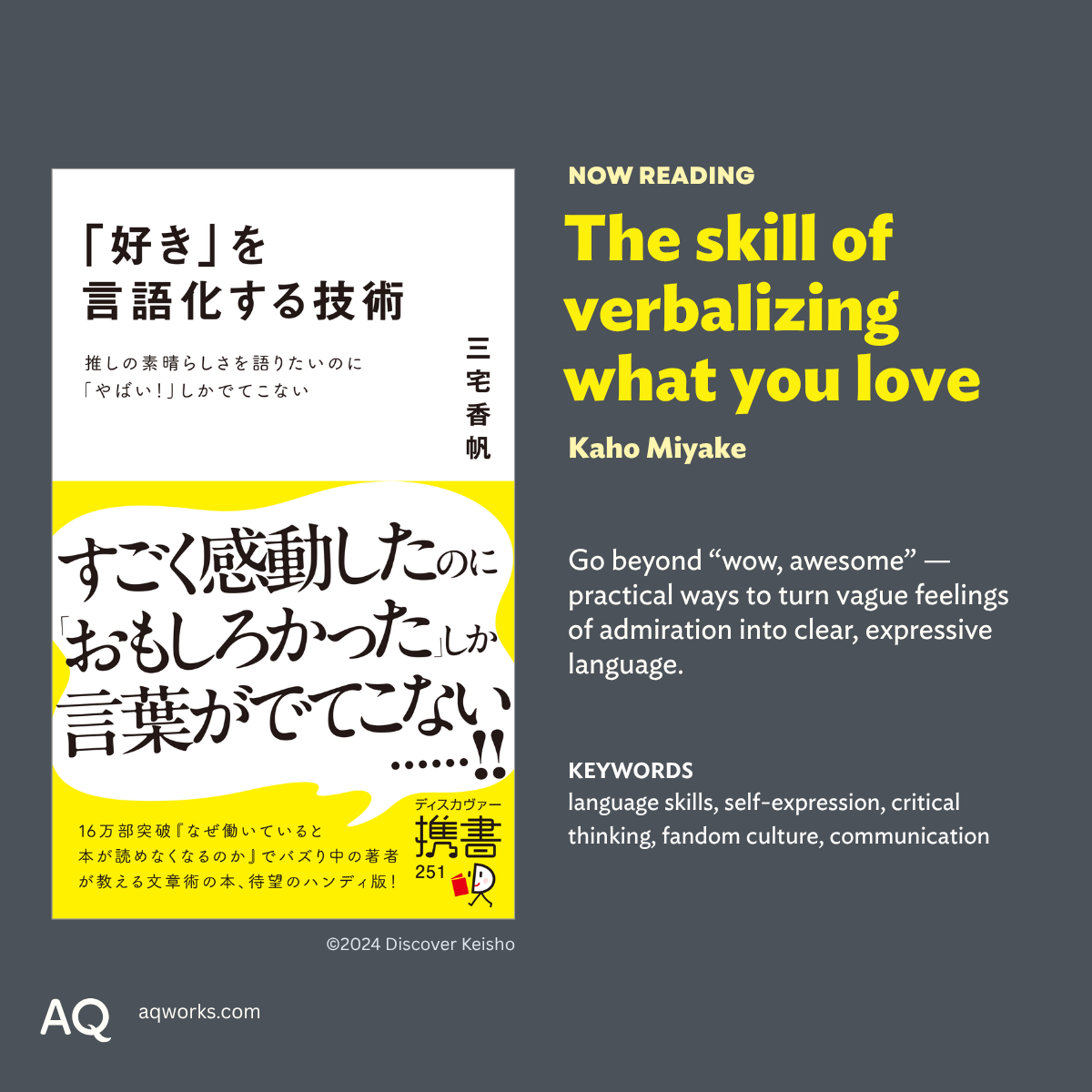
Business books move in cycles, and the theme that’s dominated shelves in Japan in recent years is “𝘨𝘦𝘯𝘨𝘰𝘬𝘢”: verbalization, the disciplined rendering of thought into language. It’s presented as a skillset to be built up to counter the coordination breakdowns in increasingly diverse workplaces.
Japan is a high-context culture, where the “obvious” or the uncomfortable is often left unstaid. The expectation is that we can, and will, “read the air”. But shared assumptions can no longer be relied on, as more nationalities, more generations and more specialized disciplines move in and out of the room. In these environments, thoughts that are not clearly articulated don’t simply risk being misunderstood–it becomes difficult to be seen, to influence, and to hold authority.
While most books on the subject orient to professional development, I was drawn to this one, “The skill of verbalizing what you love” by Kaho Miyake. It focuses on articulating your taste, rendering what you appreciate into language, so that it can be shared and more fully enjoyed. One piece of advice from Miyake is to get in the habit of jotting down what you liked or disliked about something, and why, before going online to vibe with reviews from other people. Which sounds so simplistic and yet! It forced me to confront how casually I outsource my thinking to the online hivemind.
The bottleneck of 𝘨𝘦𝘯𝘨𝘰𝘬𝘢 is not a lack of vocabulary nor is it a matter of more persuasive delivery. It’s that the task of finding the words in yourself is hard, period. 𝘞𝘩𝘢𝘵 𝘥𝘰 𝘐 𝘢𝘤𝘵𝘶𝘢𝘭𝘭𝘺 𝘵𝘩𝘪𝘯𝘬, 𝘢𝘯𝘥 𝘸𝘩𝘺 𝘪𝘴 𝘵𝘩𝘢𝘵 𝘪𝘯𝘵𝘦𝘳𝘦𝘴𝘵𝘪𝘯𝘨? Not a recap of what happened, not a rehash of someone else’s story, and certainly not a serving of AI slop… an actual point of view, expressed at a level of fidelity precise enough that another human being can work with it. That’s a skill worth building, isn’t it?